
What is ferrocement?
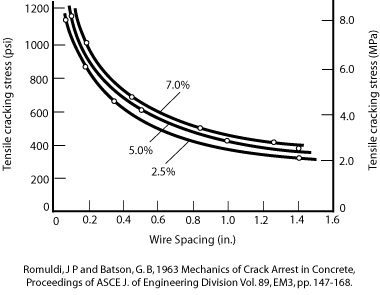
Ordinary construction cement, usually mixed with plaster sand. Normal cement is reinforced with more steel or fiber at a closer spacing than traditional construction. Reduced spacing yields uniform force dispersion and increases strength.
Ferrocement is also written as ferosim, 钢丝网水泥, ferrociment, ferrocemento, ferrosemento, ferrocimento, and ferrozement.
Are special tools required?
It is necessary to be able to cut steel and rubber gloves are necessary to protect skin from cement. A filter to avoid breathing cement dust is also a good idea. Otherwise, ferrocement is a labor intensive material which does not require pumps, compressors or even a mechanical mixer; cement and sand may be mixed on the ground with shovels, as was done in Rome thousands of years ago and is still done to this day. Never delay a project for lack of a mixer, pump or compressor; hand work is good quality and builds pride through solidarity, it's also peacefully quiet.
Why doesn't this website sell ferrocement or have advertisements?
Most tools and bulk components of ferrocement are sold at masonry supply stores. Smaller tools for sculpture are found at art supply stores.
What about Building Permits?
All one needs is a set of plans with a licensed architectural stamp of approval. It’s as easy as that. Finding an architect confident with use of the ferrocement may require a little patience.
Food for thought; ferrocement houses pay for themselves more than once per generation (low maintenance and insurance costs). Ferrocement tanks and reservoirs pay for themselves over and over by lasting longer than any other material.
What are the mixing proportions?
These proportions are dry measure. Three sand to one cement, written as 3:1 (three to one). 2.5:1 is very rich. Above 3:1 is less so.
Add water until the consistency is such that a line drawn with the index finger settles slowly. Draw the line on the surface of fresh mortar, make it 2 - 3 centimeters deep. (1" deep). Examine the speed and fluidity of collapse along the line, also known as "slump." Excess water reduces ultimate strength.
Add measured dry cement and sand if too much water.
Why is it called ferrocement if it is standard cement?
Much steel rather than much concrete. A thin shell of concrete.
It is also called ferrocement because the rich mixture makes it hard, like iron. Fibers such as hemp, jute, flax and cotton can be substituted for steel and sand (see bio-fiber in website map). Fiber spacing is very small and the overall strength increase is significant.
How long does it take to dry?
Concrete does not dry; it becomes strong through chemical change, in 28 moist days. Four to six days seems to be enough for the acrylic mixed with cement projects described in this website. If concrete becomes dry too soon it will not reach maximum strength.
Where can I learn more about ferrocement?
This website is a good place to start. A graphic shape section illustrates engineering concepts with shapes rather than words, for example. The tank construction section contains many techniques which will be useful to everyone, including artist and builder. This website describes the experience of many people. Please contribute.
The caretaker of this website has built several ferrocement houses, helped on several more, and is the product of a large rural neighborhood which experimented with ferrocement for over three decades. The region has frequent fires and earthquakes and techniques of ferrocement became part of the culture there in the 1950's. Older veterans inspected and encouraged construction during the earlier period. They knew ferrocement had helped conclude the war and were eager to assist an indigenous and vital young industry. Artistic and practical were blended. The goal was housing for everyone. Fire, hurricane and earthquake; no problem. Though ferrocement can be damaged by baking with high heat, it does not ignite and become fuel for the fire. The original advertisement was, "Ferrocement, won't rust, rot, or burn."
The goal is affordable housing for everyone. Fire, hurricane and earthquake; no problem. Ferrocement; will not rust, rot or burn.
When the veterans grew old and retired, Late 1970's, they were replaced by college graduates. Third generation neighborhood ferrocement businesses were systematically eliminated by the new government employees who were not familiar with ferrocement and didn't realize or care that it can cost more to engineer than build. "Transition you out" was the approximate translatable term used by the most ambitious of the new government employees. "Some of you will be transitioned out," was the exact phrase in English.
The website caretaker is also older now and this website passes on a little of what has been learned so it is not lost to the future.
Sculpture, reservoirs, and boats were also products. Affordable sculptured housing was a local specialty. Fire, storm and earthquake safe affordable housing that pays people to live in itself.

How did ferrocement help terminate the second world war?
Barges, barracks, buried ammunition storage and many other constructions. It was during steel shortages of this period that US Navy engineers began to experiment and construct with bamboo reinforced concrete. A copy of US Navy bamboo reinforced concrete engineering is archived on this site.
Why is ferrocement engineering so expensive?
It doesn't need to be expensive. A confident architect can create ferrocement plans for official approval with minimal calculations. A high Lloyds of London insurance rating for ferro boats pounding the high seas translates to a high safety rank for a fire and earthquake safe sculptured boat hull turned upside down and made into a house. Architects can be very confident with ferrocement homes.
Where did ferrocement come from?
Greek fresco, Roman concrete and the sculptural wire and plaster technique from the time of Michelangelo Buonarroti and Leonardo de Vinci, with modern materials. The first definite ferrocement artifact was a tourist barge pulled along canals in the Amsterdam zoo. (late 1800's)
Where is ferrocement going?
Organic fibers have once again become interesting as the cost of both steel and cement increases, space-age mud and wattle is one descriptive term used, on this web site. Use of organic fibers as reinforcement for cement is not a new idea, burlap and cement siding was used in the early 1900's, in California. Mud and bamboo are very durable, centuries-old technology, for example. And concrete is still called mud among construction workers.
Other exotic reinforcements that do not rust are interesting but can be expensive. Acrylic is also expensive yet it makes a very thin roof waterproof.
Wood, steel and concrete will continue to increase in cost. The energy content of steel and concrete will make these materials more expensive. Forest depletion and cutting fees which compensate for the economic value of a living tree left standing will eventually become very expensive. Ferrocement and the biological fiber technique, which I call space-age mud and wattle, will become a primary building material of a sustainable culture of the future.
It is important to note that population reaches a point of very gradual decline with full education and the security of a home. These are the ferrocement homes and other infrastructure of a space-age culture living in peace with Earth.
Traditional ferrocement has unique economic advantages that will ensure it continues as a material chosen to create beautiful structures, reservoirs and interesting art.
Bamboo, wood and mud after a hurricane. It survived.
