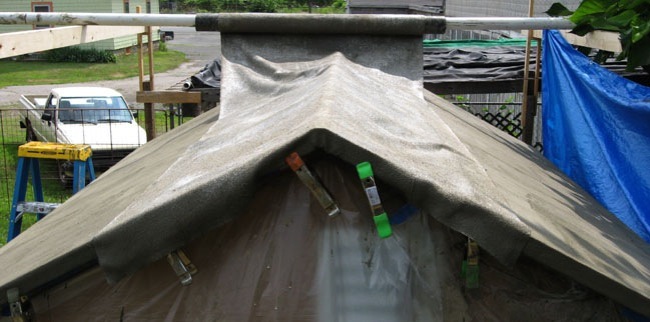
Welcome/Home
Begin Series
Continue

Scaleable truss and frame bamboo/fabric shelter - Space-age mud and wattle

Structural Meditations
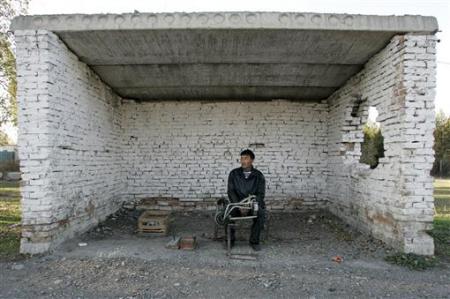

Shelter is a basic human necessity, be it a bus stop, family home, school, or regional hospital.
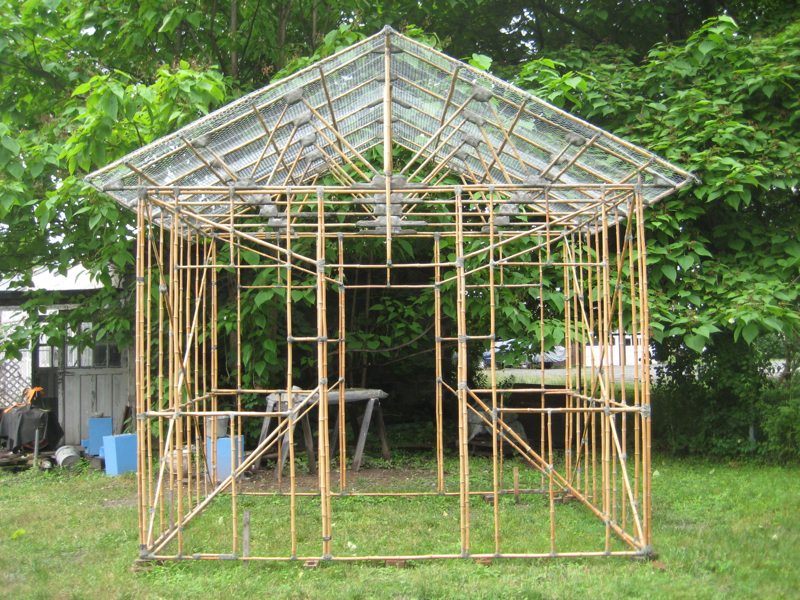
Restart this series for previous graphic design and assembly photos

Continue to portable production facility and shelter example progress


Shelter - 2009 - ecological econ
Shelter, Water, and Sanitation : Using Human Necessities to Heal the Planet

Section index

Antoon Versteegde ... The Netherlands, 2009 ¥¥¥ Center for Rural Development and Technology ... Indian Institute of Technology, New Delhi, India

Birambye ... Rwanda ¥¥¥ Water reservoir manual ¥¥¥ Water Well Basics ¥¥¥ Compost toilet


Self-sheltering

with

Space-age Mud and Wattle


Abstract


Humanity is approaching social and environmental difficulties so large it is wise to prepare an action plan for the possibility that present unsustainable social structures prove unable to change quickly enough to determine and then act upon a solution. Self-sheltering with space-age mud and wattle is a method of practicing a sustainable form of organization based on externalized profits and quality rather than quantity, while, at the same time, creating infrastructure for the vast majority of humanity partially to totally outside the wealthy consumer cultures. How to create economic units with profits that escape into the general ecology is like bees making honey while pollinating the world, or primitive bacteria creating an atmosphere suitable for modern life. Using human necessities to heal the planet encompasses a complete category of green building innovation that concentrates benefits of equity and justice on the poor in ways that modern economics has grown to include as prerequisite to a sustainable human culture. When poor and disadvantaged communities have pride of place and are secure, then billions of imaginations will be unleashed and able to provide a different perspective from which to search for a way to avoid impending disaster. We don't have much time and we need all the help we can get.


Self-sheltering with space-age mud and wattle

September 19, 2009

Example shelter frame

September, 2009 - The Netherlands

------------------------------------------------------------

Development of Space-age mud and wattle naturally leads to a community concept of cooperative shelter provision by noticing its efficiency springs from being labor intensive and its output is for low income societies with excess labor. This realization opens a backdoor to modern sustainability economics based on justice through three premises.

First : The present world population and socioeconomic structure are straining the Earth's resource base and environment to a degree that suggests possibility of a tipping point when sudden climatic change will be sufficient to cause an accompanying evolutionary shift of specie variety which may or may not include humanity. Anyone with children will find this a hard road to travel with a family.

Second : Global climate change is an indicator for the scale of many other pollution caused environmental impacts, and most national governments have not evolved sufficiently to change the level of resource consumption and pollution output to avert impending ecological collapse. There is no basis for predicting a shift in government function from promoting the form of quantitative economic growth which has resulted in our current cultural and ecological conundrum.

Third : Self-sheltering using Space-age Mud and Wattle is a green building technology which can be used to rapidly provide decent housing and sanitation for everyone on earth. Furthermore, satisfaction of these life necessities presents one of very few opportunities for Humanity to alter its evolutionary trajectory, away from looming disaster and toward sustainable qualitative growth.

World population is forecast to increase by an additional forty percent, 2.5 - 3.5 billion, within the lifetime of all but the eldest of those presently alive. Since upward mobility among economic classes is limited, populations in the higher economic classes are static to declining, and the most readily available resources have already been consumed, the majority from population growth have a high probability of joining those already lacking in basic necessities required for a decent life. A rough forecast of 7.5 billion economically disadvantaged people out of a rapidly approaching nine billion human population is reached by including 2.5 billion who are economically stressed to a degree which limits opportunities of education, proper medical care, or a relaxed, fun way of life. This demographic is meant to be indicative only, it marks an area of innovative sheltering that is often not included in discussions of rapidly evolving green building techniques that serve a prosperous minority.

The purpose of this discourse is to aquaint economists and others with some available practical tools for implementing a sustainable human economy and to clearly establish that green building innovations may be factored to include innovations which serve the poor in such a way as to proactively benefit the environment through increased social equity and justice while yielding a new direction for social evolution which present governments may not be able to accomplish. These excerpts from the introduction to the Human Impact Report - Climate Change - Global Humanitarian Forum - Geneva, by Kofi A. Annan, President of the Global Humanitarian Forum, page 6, are meant to assist the United Nations which is meeting with the express purpose to define a course for a sustainable human culture, December, 2009.

"If we do not reverse current trends by close to 2020, however, we may have failed. Global warming will pass the widely acknowledged danger level of two degrees, since there is an approximately 20 year delay between emission reductions and the halting of their warming effect. This report clearly demonstrates that climate change is already highly dangerous at well below one degree of warming. Two degrees would be catastrophic...

"Weak political leadership as evident today is all the more alarming then. It is not, however, surprising, since so few people are aware of just how much is at stake. That we are already this far into the most important negotiations ever for the future of this planet without a clear idea of the full impact of climate change on human society speaks volumes in itself. In this respect, I hope that the report will change political attitudes, spur public debate and more research...

"We live in a global village and we each have a responsibility to protect our planet. IsnÕt it logical and equitable, therefore, to insist that those who pollute have a duty to clean up? Pollution by some affects us all. Every one of us needs to understand that pollution has a cost, and this cost must be borne by the Polluter. Least responsible for greenhouse gas emissions are the worldÕs poorest communities who suffer most from climate change. This is fundamentally unjust. If efforts to build a global framework to address climate change are to succeed and endure they must be based on the principles of fairness and equity. People everywhere deserve climate justice. And everywhere people must stand up and demand exactly that from their representatives. A fair and just approach would facilitate agreement at the UN Climate Conference in Copenhagen later this year. We cannot afford to fail."

Self-sheltering with Space-age Mud and Wattle is a mature and ready to implement green building technology which can give practical support for the changes that Kofi Annan concisely explains are needed. Using human rights to heal the planet encompasses a complete category of green building innovation that concentrates benefits of equity and justice on the poor in ways that modern economics has grown to include as prerequisite to a sustainable human culture. We know that the poorest among us damage Earth the least. And we also know that there are not enough resources or planetary pollution disposal services for all of humanity to live as the consumer societies do. Therefor, self-sheltering innovations which lead to a sustainable culture via concentration upon benefiting the poor is a direction for focused commitment of effort by governments, architects and non-governmental organizations whose energies and skills are much needed if a sustainable culture is ever to be.

A world-wide network is at this very moment becoming aware of itself as formerly isolated researchers and practitioners of this aspect of shelter innovation share discoveries. The most recent contact was August, 2009, Dr. Sudahakar Puttagunta of the Indian Institute of Technology - New Delhi (IIT-D). Dr. Puttagunta became involved on a path leading to this work during his European travels after graduation from college in India, 1979-80.

Bamboo arch test - Indian Institute of Technology, Delhi
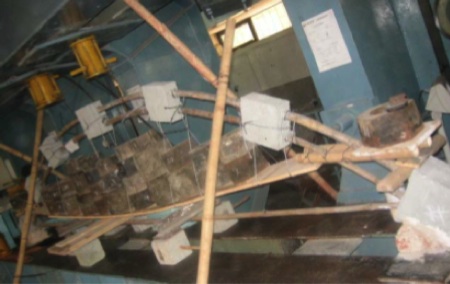
Bamboo-concrete composite arch with 880kg of nearly distributed load

Dr. Puttagunta's closing remarks in a recent communication with ferrocement.com are quoted here as a method of verification regarding the scope of sheltering technology included here.

"It shall be my pleasure to interact and collaborate with you in search for mass housing while healing the ecological wounds instead of further aggravating the wounds in the name of development, where livelihood issues of the disadvantaged and rural communities also get positively benefited."

This summary sentence opens a large discussion of modern sustainable economics involving Justice, Equity, and the Laws of Physics, all of which require full accounting for all costs. The larger topics are reconciled and subsumed with green building in several ways:

1) Tracts of unproductive land may be made green and utilized to grow bamboo or rot-resistant sapling varieties to be used as frame material for structures which are scalable from very small super low-cost shelters to larger buildings such as schools and hospitals. Relief of forest harvest pressure for construction material will provide wildlife sanctuary, CO2 sequestering in forest re-growth, recreation on the commons, and income from eco-tourism.

2) Agricultural land is used to grow annual crops such as cotton, jute, hemp, and flax for the surface sheathing/skin of structures framed with bamboo or small tree saplings. This further reduces stress on forest harvest, as-well-as reducing ecological damage from energy intensive cement, steel and quarry production.

3) Cement is often and correctly pointed to as an environmentally harmful material in the production stage prior to use. Utilization of bamboo or saplings, admixes and fabric to enhance concrete mitigates this adverse environmental impact by allowing application at a thickness comparable to skin, rather than as a heavy mass reinforced with steel. Standard construction cement is the primary binder which creates a long-lived composite, referred to here as Space-age Mud and Wattle. This composite may also replace plastic siding, which becomes brittle in sunlight and eventually decomposes into various pollutants, referred to as endocrine disrupters, which mimic estrogen and can now be found in almost every living cell on earth.

4) Emulsified acrylic is currently the easiest admix used with standard construction cement and fabric to create a thin and semi-flexible structural membrane or skin which is completely impermeable to water. This is the sole technically complex product which is not always readily available in every location and may need to be imported. Although there are other polymer admixes, emulsified acrylic is relatively safe to use and is also favorably price sensitive to quantity purchases.

The described construction material is also an excellent sculptural media allowing for flexible architectural design and creative expression in tune with local aesthetics. Creating a beautiful home engenders pride of place and if broadly embraced, has the potential to enhance human dignity for the billions who are now or may in the future be deprived of a decent human living standard. There is still enough to share outside the consumer society to establish a parallel culture that need not be a hopeless quagmire of poverty and a source of disease, discontent, and political instability. This labor intensive green building technology can be efficiently and affordably scaled to bring billions a safer, more livable and and more sustainable way of life. While it is true that this parallel culture does and will continue to outnumber the consumer culture, even with dramatic enhancements in living conditions it will remain unable to contribute much to existing governmental tax flows for a long time. Nonetheless, an immediate net positive will be realized in the form of significant reductions in social and environmental chaos costs, and from the potential evolutionary contribution centered on sustainable qualitative growth, rather than unsustainable quantitative growth.

Building codes prevent use of super low-cost, space-age mud and wattle in many regions, thus, it is sensible to concentrate assistance upon those in regions where official policies will be supportive of an effort to empower the population through Self-sheltering. The Self-sheltering green building technology presented here supports a culture where shelter is considered an attainable life necessity equal with health, education, clean air, clean water, clean dirt, food, freedom, fun, friends, family, and biodiversity sufficient to maintain a viable planetary gene pool. When the techniques are well known and material costs are a minor component given reality by extensive labor, it is entirely reasonable to propose a rapid increase in architecturally beautiful and functional shelter for the rural poor as-well-as disadvantaged communities. It is in this direct effort where a union of professional architecture and the humanitarian community can leverage their skills to motivate governments through accomplishing a clear example of grass roots evolution toward a sustainable future.

The process of creating millions of homes will also set up a bi-directional communication of knowledge which transmits local wisdom from an impoverished or disrupted area to various university systems, before it is lost. A primary goal of this model, therefore, is enhanced information flow from specific projects. Space-age materials and their associated techniques move towards the victims of disaster or poverty and are then incorporated into local solutions which may be as ancient as mud and wattle. Synergy from local solutions and designs applied to a particular blend of modern and local materials then completes the cycle and becomes information leading to new frontiers for design and applied materials research by universities and laboratories. An interesting example of this occurred when a Colorado NGO known as Birambye successfully exported this technology to a lakeside Rwandan location where many old fishing nets had been saved; the Rwandans then decided, on their own, to insulate the roof with thatch on top of the cement/fabric membrane and hold it in place with their old fishnets.

New self-sheltering style kitchen built using space-age mud and wattle at Rwandan orphanage

Successful technology transfer to Rwanda by Birambye includes bamboo wrap joints developed at ferrocement.com

Use of space-age mud and wattle to construct shelters, small hospitals and schools is an exercise in bi-directional cooperation rather than unidirectional donor aid to a passive victim. There are no super-stars in this description of self-sheltering with space-age mud and wattle. The Rwandan example clearly shows that this green building technology has already proven to promote, recognize and record synergies between old and modern skills and technologies. While it is true that synergy is not science, it can be used scientifically, and that is an important part of this method to assist in the generation of millions of shelters and associated infrastructure involving potable water, sanitation and public facilities necessary for a modern, quality based sustainable culture.

Sanitation and safe drinking water are two additional requirements fundamental to a viable culture. Ferrocement is the steel reinforced version of biological fiber reinforced concrete and utilizes the same skill set, it has been the superior choice for water storage since Robert Mailart began building ferrocement water tanks and bridges on the European continent, circa 1900. Ferrocement and space-age mud and wattle are both ideal for permanent installations of composting toilets that can replace millions of temporary composting units which need to be distributed as quickly as possible and then collected and redistributed as permanent composting facilities are constructed.

Self-sheltering and its supporting technologies constitute a green building initiative capable of helping the most people, those who are in greatest need. Space-age mud and wattle consisting of bamboo or saplings, fabric, and acrylic mixed with standard construction cement leads to understanding economic principles that spring from the needs of billions who's imagination and creative energy we do not enjoy because they are overwhelmed with the daily effort of survival in poverty or the aftermath of disaster, man-made or natural. Self-sheltering is a major component for establishment of justice and equity, prerequisites to a new and sustainable human culture. Immediate large scale training and material assistance for self-sheltering with space-age mud and wattle will establish a sustainable culture that may still have time to avert impending conflict over limited resources and increased disaster frequency from climate change or pollution. There is not much time left and this area of green building technology has the potential to quickly enlist millions to provide themselves with shelter and at the same time develop practical methods for qualitative growth and the dawning of a sustainable new age.

When the worlds poorest communities have adequate shelter sufficient to engender pride of place, the residents of those communities will, as all humans do, work to improve and grow. They will begin a new industrial revolution with more people than were alive when the first one started, and they will be starting from a polluted world that no longer contains readily available resources to repeat what the consumer culture has done. Thus, as the children of these communities become educated - it's what humans do - a huge pool of newly educated imaginations will step forward with art and science which first stands on self-sheltered dirt floors and then reaches for the stars. And those from the consumer culture will have planted and helped nurture a sustainable example to follow and live by. Liberty and justice for all will fuel the billions of unused imaginations required to avert ecological and social disaster. This is the central tenant of modern economics and there is little remaining time to implement it.

The most readily available construction material for the urgent need of self-shelter is referred to as space-age mud and wattle, it utilizes the lowest grades of bamboo or straight saplings as preliminary support and mold. The bamboo or young trees are first bound into a supporting frame and then encased from the inside to the sheathing membrane on the outside. A layer of chicken wire, or woven poultry netting, is applied to the frame and then sandwiched between outer and inner layers of fabric. The wire layer acts as rip-stop and makes it impossible for wind to rip the finished membrane should it be damaged by flying debris during a major tempest. The encasement of frame members also attaches the outer membrane to the frame and changes each frame member into a semi-passive mold for creation of a surrounding fiber composite mini-girder, the result is similar to bicycle frame tubing or a hollow sailboat mast.

Although little notice has yet been made of this membrane attachment method or the advances made in joint techniques, and there are very few known developers of these very low-cost technologies specifically designed for highly competitive small-scale entrepreneurs, as-well-as cooperative self-sheltering, this direction of effort will eventually become an important factor in creation of a just and sustainable human future. The question now is will architects and prime movers in the humanitarian community seize the initiative and grasp the idea of these labor intensive efficiencies in time to nurture consciously chosen evolutionary steps, with or without positive government leadership, after the United Nations Climate Conference this December, 2009.

Actual construction of a village neighborhood using Space-age Mud and Wattle begins with a training session that creates a design and builds the first prototype. Frame joints of the various walls and roof trusses are wrapped with duct tape and, when all the wall and roof components are assembled, they are bound again with 3 x 50 cm ± strips of muslin which have been soaked with cement and acrylic mix, phosphate base cement, or waterproof carpenter's glue. One person of a two person crew soaks the strips and rolls them onto short pieces of bamboo, the second person binds frame member joints by wrapping the joint similar to the way a bandage is wrapped on an injured wrist or knee. The completed frame sections are cut away from each other after the prototype frame has had enough time to harden to full strength.

Representatives from nearby universities, villages and neighborhoods will also participate and be trained as trainers during the construction and disassembly of the first prototype. Mothers, fathers sisters, brothers, friends, neighbors and future trainers will then construct a jig made of parallel fences of bamboo, saplings or lumber, constructed as the wall and roof panels were, with a top rail at workbench height. Disassembled frame panels are laid upon the parallel rails and short vertical pegs are wrapped onto the rails in such a way as to hold each frame member in position, exact for the structure measurements, but not too tight for each piece. Now the time has arrived for music and a feast to celebrate the community's new ability of self-sheltering with space-age mud and wattle.

The next morning, after the celebration, when the jig is cured and all its joint wraps are strong, the prototype wall, truss, and roof panels are removed from the jig and placed upon the next set of parallel rails to make a second jig. Frame jigs are easy to build and can be altered as design modifications occur.

The first jig is ready for new wall, truss, and roof panels, which are made as exact copies of the prototype by placing new lengths of bamboo or saplings in the positions created by the pegs on the jig made from the prototype. A layer of chicken wire is placed on the new bamboo frame and then a layer of muslin or some other fabric on top of that. Chicken wire is secured to the bamboo frame with spiral wraps of wire or string soaked in cement/acrylic mix. A smooth plaster of short fiber is spread along each frame member after the wire is in place and immediately prior to placing meter wide rolls of cement and acrylic soaked muslin or other fabric on top of the wire. This plaster tangles into the poultry wire layer and creates a bedding bond for the future inner layers which enclose the frame member and convert it to a mini-girder. Fabric is thoroughly soaked with cement and acrylic and easily rolled onto a length of pipe for moving from material application station to placement on wall or roof panels, there are many ways to do this.

ferrocement.com - 2007


Fabric soaked with acrylic and cement has been placed on plastic pipe and then rolled into position.

Trainers and trainers of trainers work with local neighbors to lash together the wall and roof panels and assemble the first new shelter. When the lashing, finish corner layers and other beautifying work is completed, it will again be time for music and celebration, in whatever manner is traditional and appropriate for family gatherings. In this way the new quality based culture will learn that fun is one of the actual economic components that replaces the illusory monetary security which members of the old quantitative culture chased after until almost destroying the planet. Here we see how community based shelter construction helps create externalized profit sufficient to become a new norm that supports a sustainable culture with liberty and justice for all; where all includes everything that lives and will live.


ferrocement.com resource archive

Sculpture - 2008 ... Sculpture manual
Space-age mud & wattle ... ferrocement

Shelter-2009 ... Begin this series again
for previous graphic design and assembly photos

Continue ... Portable Production Facility

Center for Rural Development and Technology ... Indian Institute of Technology, Delhi
Experimental verification of bamboo-composite bow beam with ferrocement band.

Antoon Versteegde ... Bamboo house frame, 2009

Birambye ... biological fiber and bamboo kitchen, Rwanda, 2008

For sharing the water tank manual, see

Water reservoir manual, includes rainwater storage and sanitation systems

also, Water Well Basics (web only)

and, for sanitation,

Compost toilet ... flycatcher example illustrating architectural design components for permanent installation
sized at three units for two people.
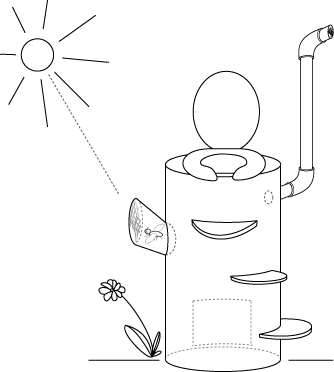
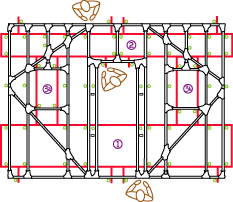
Ferrocement and space-age mud and wattle are both ideal for permanent installations of composting toilets that can replace millions of temporary composting units which need to be distributed as quickly as possible and then collected and redistributed as permanent composting facilities are constructed.

Temporary toilet example

Continue